What Do You Call It When You Know a Language but Cant Speak
Back when I was starting to learn French, just like whatsoever other student of a foreign language, I resorted to translating words rather than understanding the language. Gradually, equally I adept more than and more than, I began to get a hang of its words and grammar, and could sympathise 20-25% of two people talking in French. I could also sympathise some moments in French movies and songs.
Withal, despite showing reasonable progress in agreement the language, my performance in spoken French was nil short of abysmal. I could (partially) understand the language, only wastruly bad at speaking French myself. Now, this was not just my struggle; I took sadistic pleasure in seeing that most of my classmates were every bit bad as me – if not worse.
Still, this peculiarity is certainly something to ponder over, isn't it? As we learn, we tend to understand a language pretty well, just when it comes to reproducing through words (either spoken or written), we oft struggle.
Why is that?
Recommended Video for you:
Understanding/Recognizing vs Reproducing
Information technology's of import to understand the departure between these ii activities, which is where the answer to our question lies.
Y'all encounter, recognizing/agreement something is mostly much easier than reproducing it on one's own. I'll illustrate this with the assistance of an example: suppose you have all the words of a foreign language (say, Spanish) printed on a piece of paper, and imagine that they are all in alphabetic gild. The first stack has all the words starting with 'A', the second stack has all words starting with 'Be' (Spanish 'B') and so on.
Now, when someone says the word 'despacito' in forepart of you lot, you instantly annals that the discussion starts with a 'De' (Spanish 'D'). Afterward, you expect for the word 'despacito' in the stack of words starting with 'De', locate it, and translate its meaning to English language ('despacito' translates to 'slowly' in English language).
This process seems a little cumbersome and long-winded, but the thing to note is that all of it happens within your head. In reality, you don't acquit effectually a stack of Castilian letters, do you? Yous merely hear the word and you lot 'run' information technology inside your encephalon'south database, looking for matches. When the match is found, smash! You know what the word means.

It's easier to understand a new language than to reproduce it. (Photo Credit : Pixabay)
Now, let's consider some other scenario. This fourth dimension, you are shown a picture of a cat, and asked to say what'due south information technology called in Spanish. You all the same have that all-words stack with you lot, only you realize that it's not helpful in the to the lowest degree! You can surely translate a word that's given to you, but you are at full loss if you are asked to "find" the correct word (for a item object) on your own. This is the basic reason why agreement and reproducing a language are two entirely different things, and why the one-time is commonly considered easier.
The trouble with 'understanding' a language
More than often than not, information technology just and then happens that while 'agreement' a conversation taking place in a foreign language, you basically empathize the comprehensive significant of what's being said, but not the word-for-word pregnant of every sentence. The context helps a lot too.
For instance, suppose a Frenchman approaches you and says "Excusez-moi, où sont les toilettes, s'il vous plaît?" Even if you lot know basic French, you'd get the idea (due to words similar 'toilettes' and 'ou') that the gentleman wants to know how to achieve the nearest toilet (lavatory).

In most cases, it'south the meaning of sentences that nosotros try to understand, rather than the individual significant of every unmarried word in the sentence. (Photo Credit : Pexels)
However, if the aforementioned situation is reversed, i.eastward., you lot go to Paris and accept to ask for directions to the nearest toilet, you will likely struggle to form unabridged sentences correctly and then speak them to a friendly French gentleman. (Pro tip: You should learn, for your own good, all the bones French sentences before taking a trip to Paris).
Now, let'south look at the biological aspect of this whole thing…
The Wernicke's surface area and Broca'due south area in the encephalon
'Language', every bit a whole, is handled by a specialized region of the encephalon, but hearing/understanding and speaking are handled by divide regions of the brain.
Wernicke's area in the temporal lobe deals with linguistic communication agreement and comprehension, while Broca's surface area in the frontal lobe handles speech language production.
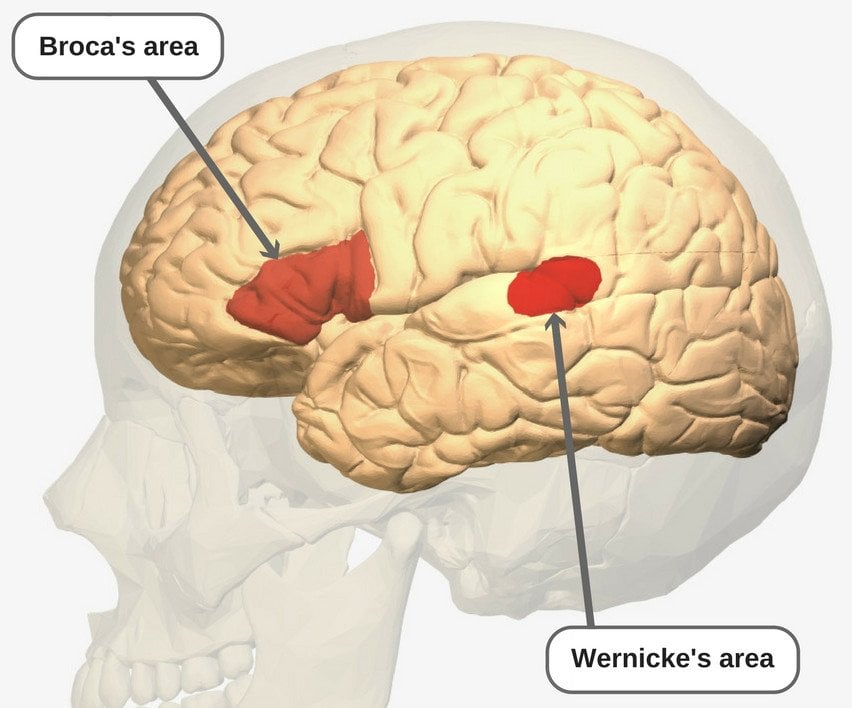
The Wernicke's area and the Broca's area in the encephalon(Photo Credit : Polygon data / Wikimedia Commons)
Thus, language comprehension and reproduction are Non handled by the aforementioned part of the encephalon, which might further explain why understanding and reproducing a language may non necessarily go hand in manus.
Although they are in different regions of the brain, both of these areas are connected past a bundle of axons known as the arcuate fasciculus. It should be noted that these two regions may accept dissimilar functions, but they are non the only two regions involved in the comprehension and production processes.
All in all, the fundamental to properly speaking a language is practice. If you don't really practise speaking, you might get good at understanding a language, but you will never be able to perfect the 'reproduction' attribute of the language.
As a event, if you get on a trip anytime to a foreign land, and you're peculiarly unlucky and technologically-challenged, you lot will have to bear the discomfort of holding in your pee for a very long time, and only hope that a compatriot comes to your rescue and guides you to your destination.
Help us brand this commodity better
Source: https://www.scienceabc.com/eyeopeners/how-can-we-sometimes-understand-a-language-but-not-speak-it-very-well.html
0 Response to "What Do You Call It When You Know a Language but Cant Speak"
Mag-post ng isang Komento